About the role
We are looking for an experienced and passionate Lead Engineer Flight Control to head our young and growing flight control team. In this role, you will be responsible for the specification, development and testing of the guidance, navigation and control (GNC) and functional software that guarantees safety and performance for flights under all specified conditions. You will define the control architecture, derive and validate the GNC requirements, and shape the strategy and roadmap for the GNC and functional software of an unmanned VTOL transition aircraft. You will lead a small team of flight control engineers while staying hands-on in design, analysis and testing, and you will ensure compliance with industry standards, including DO-178C and DO-331, throughout the design lifecycle.
What you will do
What you’ll do in your day-to-day:
• You derive and validate GNC requirements, and make the decisions on design, architecture and process.
• Designing, implementing and maintaining all aspects of the GNC software falls within your responsibility, including control architecture, allocation and gains, navigation and estimation, modes and automation, voting and monitoring.
• Functional software and component-level control are specified and maintained by you within the agreed development process.
• You shape the strategy and roadmap for the development of the GNC and functional software, breaking it down into tasks for the flight control engineers.
• Processes that ensure safe development are established and maintained by you, e.g. according to DO-178C and DO-331, ARP4754B and ARP4761.
• Tests and verification & validation, including stability, robustness, performance and handling qualities, are executed and documented by you.
• Close coordination with multi-disciplinary teams, including aerodynamics, simulation, systems and structures, ensures the feasibility of GNC requirements.
• Clear and gapless documentation and traceability are maintained by you, along with diligent change and configuration management.
what you bring
This is what you’ll bring to the team:
- You hold an academic degree in Aerospace Engineering, Control Engineering or a comparable technical course of study.
- Five or more years of professional experience in guidance, navigation and control, including responsibility for design and verification, form part of your background.
- A clear understanding of safety-critical development processes based on DO-178C, ideally combined with ARP4754, is something you bring to the table.
- Strong experience with model-based software development using MATLAB/Simulink rounds out your technical skill set.
- Leading a small team technically while remaining hands-on is something you're capable of.
- Target-oriented self-management comes naturally to you, along with the ability to work both within a team and autonomously.
- Strong problem-solving, communication, and technical writing skills complete your profile.
- Fluent English rounds out your qualifications.
The following would further strengthen your application:
- Experience with modern model- and sensor-based flight control techniques, as well as handling redundancy, saturation and control allocation for over-actuated aircraft, is a plus.
- Familiarity with navigation and state estimation, such as sensor fusion and air data algorithms, adds to your profile.
- Knowledge of EASA regulations and guidance material for UAS and eVTOL development, such as SORA, SC Light-UAS or SC-VTOL, is a valuable asset.
- Experience with flight test campaigns for flight control functions, from test planning and readiness through to data evaluation, strengthens your application.
- Building up or growing a small engineering team, including hiring and mentoring, is something you've done before.
- Experience with SIL/HIL environments and automated testing of flight control software rounds out your qualifications.
What we offer
- Full-scale aerospace engineering — not concept slides.
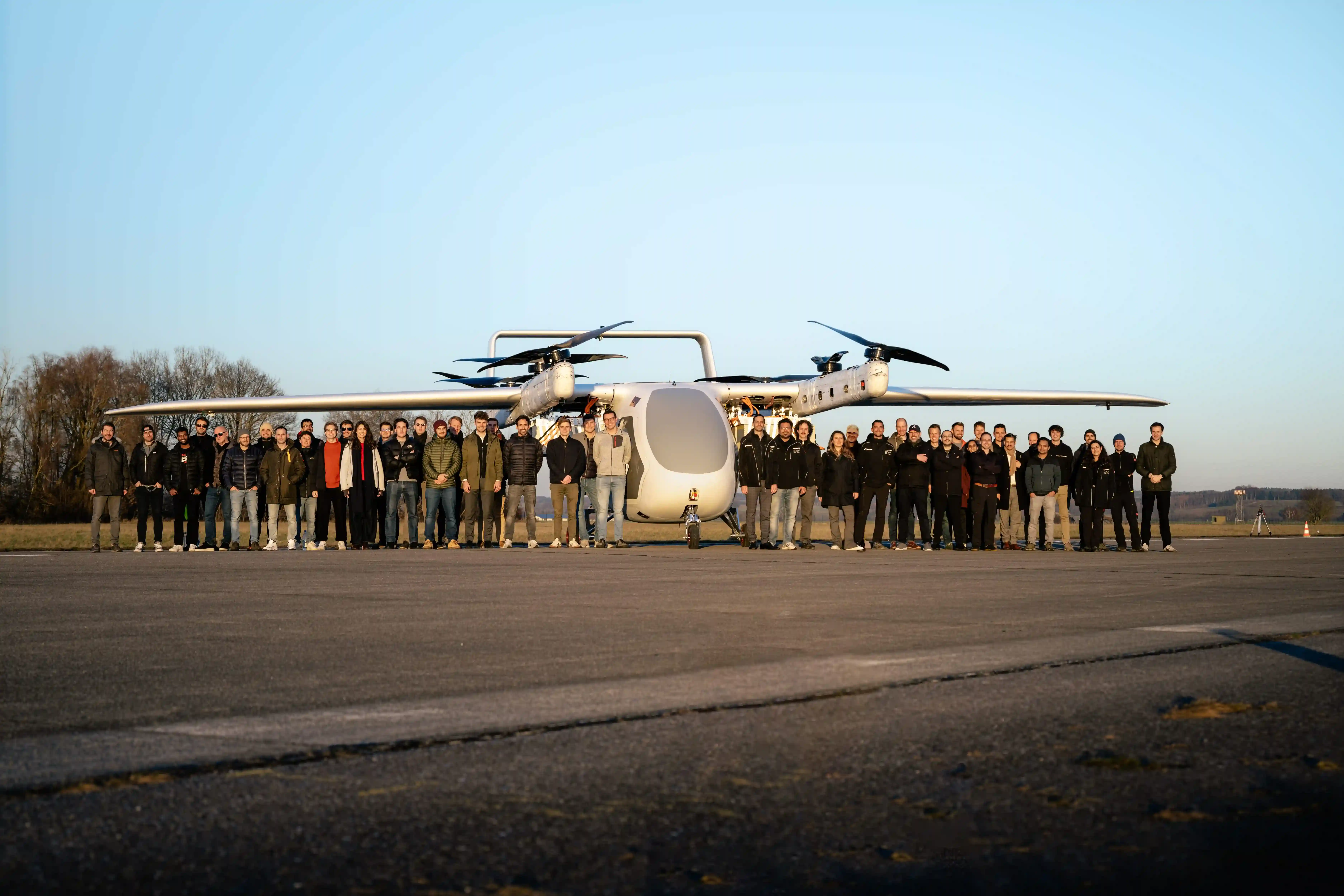
- A 60+ engineer team at Ottobrunn, backed by IABG and developed alongside TUM and DRF Luftrettung.
- Competitive compensation.
Your team
The HIRING process
- Introductory Chat
- Technical or Functional Deep-Dives
- On-site Interview and Get-to-Know
- Decision